Help › Trips, duty and rest
Rest plans and jet lag
How the body clock, light, sleep pressure and naps work on a layover, and how LogAloft's rest plan turns your schedule into when to sleep, eat, nap and get daylight, with a worked example of an overnight to London.
A rest period on your schedule is a stretch of time; sleep is what you manage to do with it. This guide explains the science that decides how well you sleep on a layover (the body clock, light, sleep pressure, naps, caffeine) and then shows exactly how LogAloft's rest plan uses your schedule to suggest when to be in bed, when to eat, when to nap and when to get daylight. It ends with a worked example: an overnight from New York to London and a 26-hour layover. It's written for pilots and flight attendants; passengers get the day-by-day jet lag part.
The rest plan is general guidance from published sleep research, not medical advice, and it is not a fatigue risk management system. People differ, and some medicines and conditions change what's safe. Your company's fatigue policy comes first, and if you're too tired to fly safely, say so and don't fly (14 CFR 117.5 for US pilots). Talk to your doctor, or your AME, before taking anything to sleep.
The science, briefly
Two things decide when you can sleep
Sleep researchers describe sleep with two processes (Borbély and colleagues). Sleep pressure builds the longer you're awake and drains while you sleep. The body clock (the circadian clock) runs on a cycle of about a day and makes you alert by day and sleepy by night, whatever your sleep pressure says. You sleep best when both agree: a full day awake, ending in your body's night.
Crossing time zones pulls them apart. Your sleep pressure follows what you did; your body clock stays on the time zone you came from and catches up slowly. Sleep that falls in your body's day is shorter and lighter, even after a long night awake (Dijk and Czeisler, 1995).
Your low point travels with you
Your alertness is lowest in the hours before dawn on your body clock. Part 117 calls 02:00 to 05:59 during a physiological night the window of circadian low (14 CFR 117.3). On a layover your body clock hasn't moved, so that window falls at home time, which can be mid-morning where you are. That's why the first hours after an eastbound overnight feel so heavy, and why a flight back during your body's night needs a planned nap before it.
Light is the main lever, and timing decides which way it pushes
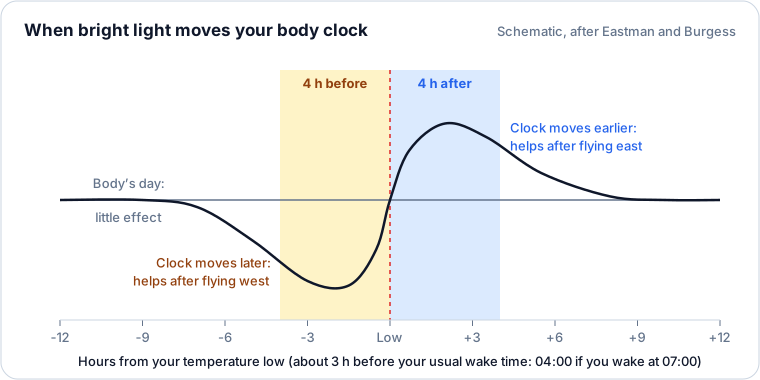
Light reaching your eyes is the strongest signal that resets the body clock. Its effect depends on when it arrives on your body's clock, measured from your temperature low, which falls about 3 hours before your usual wake-up time (Eastman and Burgess). If you usually wake at 07:00, your low is around 04:00 home time.
- Bright light in the hours before the low moves the clock later: that helps after flying west.
- Bright light in the hours after the low moves the clock earlier: that helps after flying east.
- Light in the middle of your body's day has little effect.
Burgess's protocol uses about four hours on each side of the low. Going east, LogAloft starts the light an hour after the low: with a 1-hour pulse, light only begins to move the clock earlier about 2 hours after it, and the low is often a little later than 3 hours before waking (St Hilaire et al. 2012).
The catch is that your temperature low travels with you. Land in Europe at 07:00 after an overnight from the US East Coast and your low, still on home time, is around 09:00 local: morning sunlight on the way to the hotel lands before it and pushes your clock the wrong way for adapting east.
East is harder than west
The body clock moves toward local time only so fast: about 1.5 hours a day after flying west and about 1 hour a day after flying east, according to the CDC Yellow Book. Most people's clock runs a little longer than 24 hours, so staying up later comes easier than going to bed earlier. After crossing about eight or more time zones eastward, the clock often goes the long way around and shifts later instead (Burgess).
On a crew layover of a day or two, that arithmetic means one thing: you won't adapt. The goal is not to shift your clock but to get enough good sleep at the right time before the next report.
Sleep inertia, naps and cycles
Waking up brings a period of grogginess, sleep inertia, that is worse after sleep loss, worse when you wake from deep sleep and worse in your body's night (Hilditch and McHill, 2019). Sleep comes in cycles of roughly 90 minutes on average, which is why naps are planned as one or two cycles, but cycles vary, and the stage you wake from matters more than the exact length (Tomzig and colleagues, 2025). An alarm, and 15 to 30 minutes before anything that needs a clear head (30 to 60 after a long sleep following a night awake), matter more than hitting 90 minutes exactly.
Short naps work. In NASA's study of planned rest on the flight deck (Rosekind and colleagues, 1994), long-haul pilots given a 40-minute rest opportunity in cruise fell asleep in about 6 minutes and slept about 26 minutes; compared with pilots who didn't rest, they were more alert and performed better, through descent and landing. The CDC suggests naps of 20 to 30 minutes to keep going through the local day. A planned nap before a night duty is an established countermeasure (Wingelaar-Jagt and colleagues, 2021).
Caffeine and alcohol
Caffeine works best early in your day. In a sleep laboratory study, 400 mg of caffeine (two to three cups of coffee) taken 6 hours before bedtime still cut measured sleep by more than an hour, and the sleepers didn't notice (Drake and colleagues, 2013). Keep it out of the 6 hours before any planned sleep, naps included; after a nap, it can help you through the grogginess. Alcohol helps you fall asleep but breaks up the sleep that follows.
What crews actually get
After an 8-hour eastward overnight, 87% of crews took a long sleep on arrival that was hard to wake from, and their next nights were less efficient (Lowden and Åkerstedt, 1999). On a short westward layover, keeping home-base sleep hours greatly reduced jet lag symptoms and sleepiness (Lowden and Åkerstedt, 1998). Rest is not sleep and Jet lag east and west go further into these and other crew studies.
Where the rest plan appears
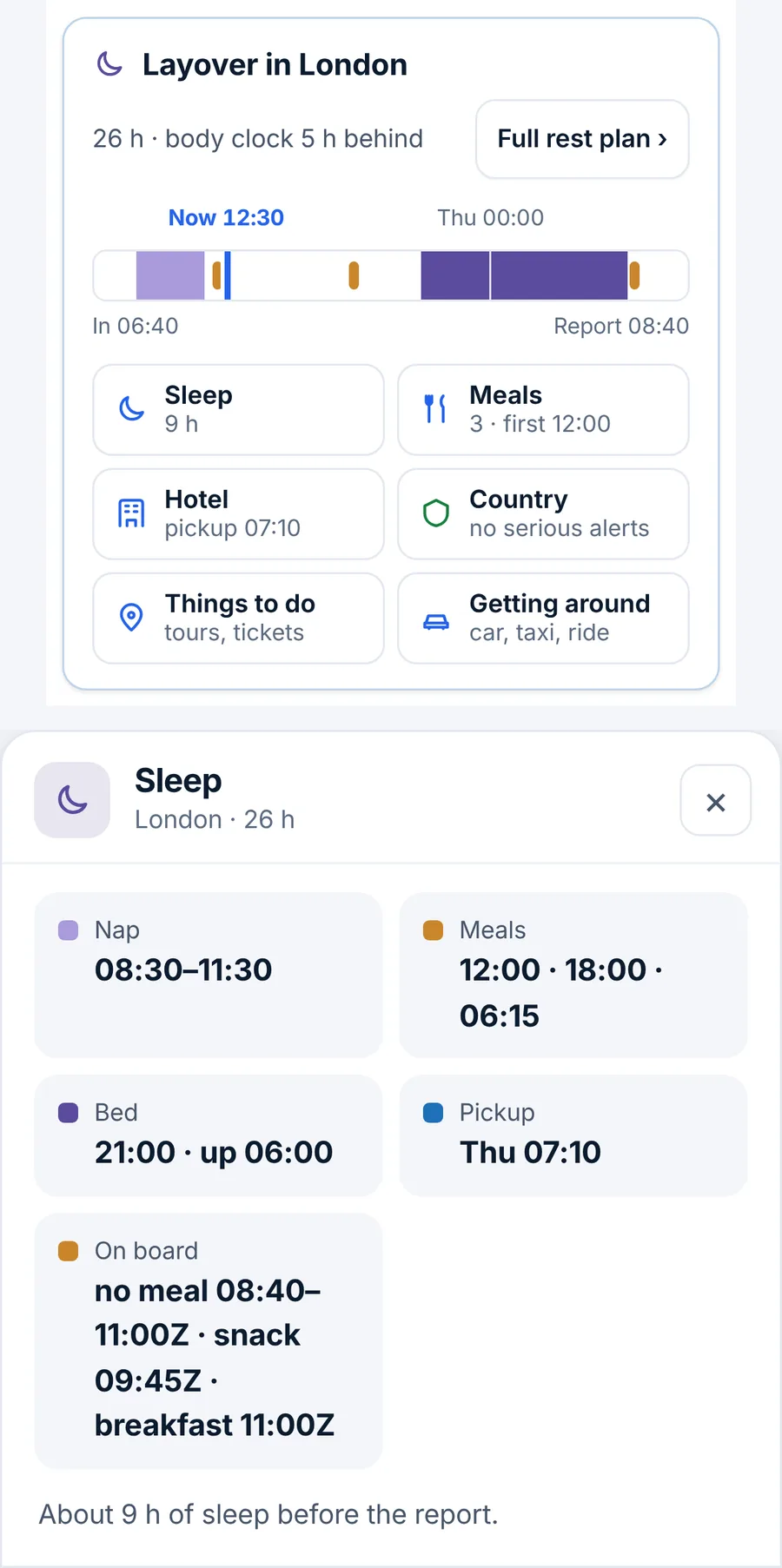
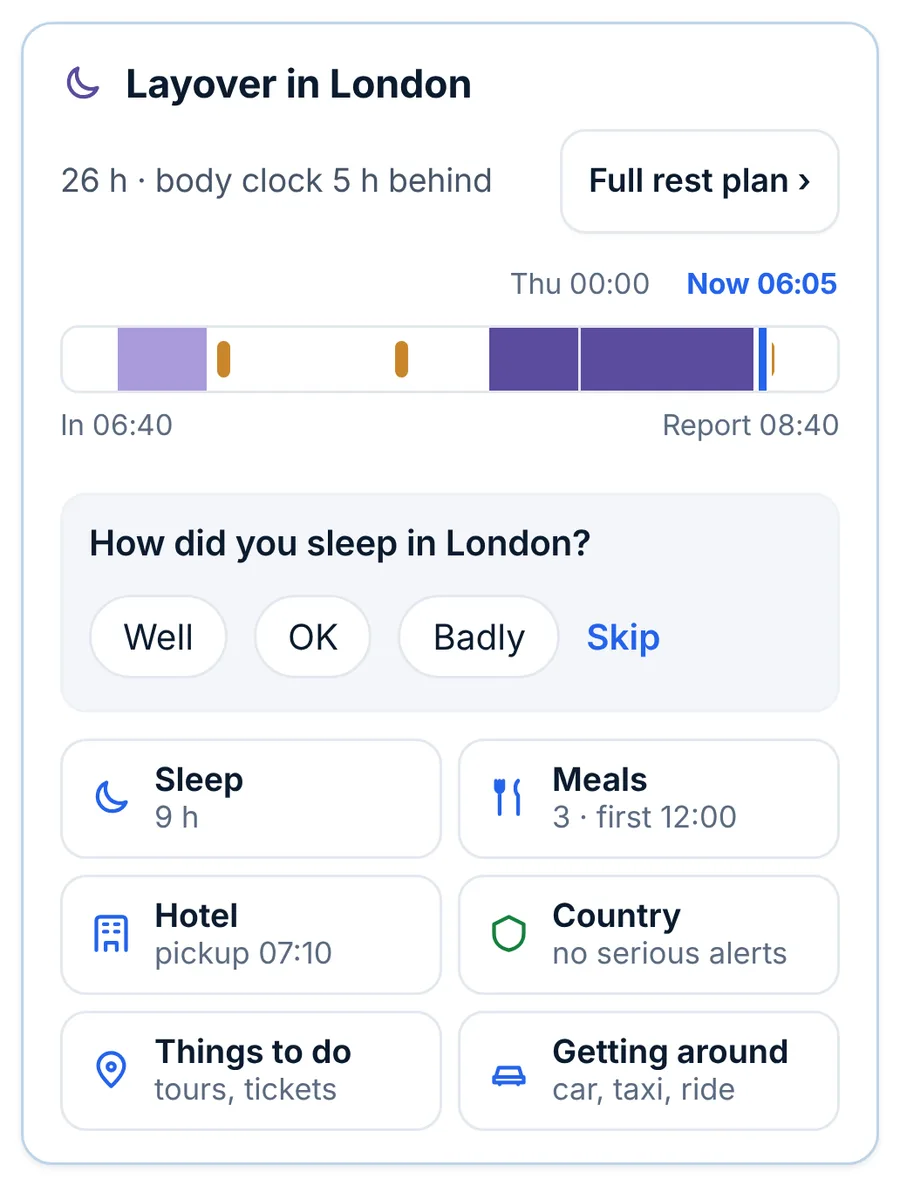
Every layover gets a rest plan, from the moment you land until your next leg leaves. In Trips, pick the day you arrive and open The day: the layover's card ("Layover in London") gives its length and how far your body clock is from local time ("26 h · body clock 5 h behind"), with a Full rest plan › button. Under that, a strip shows the layover from block-in ("In 06:40") to the report, with the nap, the night in bed and the meals on it, and a "Now" marker while you're there.
Under the strip are chips: Sleep (the hours of sleep to expect), Meals, Hotel with the pickup, and the rest. Tap Sleep for the key times, in a sheet that opens over the card:
- Nap and Bed with their times,
- Meals, and On board for the next flight,
- the Pickup or Report,
- a line with the sleep to expect: "About 9 h of sleep before the report." When it's under 8 hours, the line turns red and says how short it is.
Full rest plan › opens the plan with its reasons. On Today, the Rest plan button opens it during a layover.
For a stay of more than three days across three or more time zones, the plan is a day-by-day jet lag plan instead (below); for a shorter trip as a passenger, it suggests keeping your home sleep hours. Under three hours of time difference, there's no jet lag plan: most people adjust within a day or two.
What the rest plan uses
The plan is only as good as its inputs. It reads:
| Input | Where it comes from | Change it |
|---|---|---|
| Your usual sleep | 23:00 to 07:00 until you set it | Your usual hours, on the plan's The night before tab: You usually go to bed and and get up |
| When you got up the day you fly | Estimated: your usual hour, or 45 minutes before a hotel pickup, or 90 minutes before the report, whichever is earliest | The first dial on the plan's The night before tab, "Up on Tue 13 (JFK time)" or "Got up today" |
| Sleep in flight | 80% of your break on the leg that lands, from Breaks; without a break plan, a typical break for an augmented crew (3 pilots from 8 h 30 of flight, 4 past 12 h); none for a two-pilot crew. On a deadhead, about 60% of the flight past its first and last 45 minutes | The Sleep in flight dial, on The night before tab |
| Bed the night before | On a layover the night before, your usual bedtime | The Bed the night before dial, on the same tab |
| Your body clock | Where you've actually been over the last three weeks, moving toward each place's time about 1 hour a day earlier or 1.5 hours a day later. Commuters start on home time, not base time | Set your home airport and commuting in About you |
| The schedule | Block-in, the next report and the hotel pickup from your roster | Import the roster again, or type the pickup on the layover card's Hotel chip in Trips |
| Getting to the room | Passengers off 15 min, passport control 15 min on an international arrival, the drive (the hotel's drive in traffic when you're signed in with a hotel, else 40 min), check-in 10 min, settling in 20 min | Add your hotel with the layover card's Hotel chip in Trips |
| Up before the pickup | 1 hour | Up before the hotel pickup (45 minutes to 2 hours) |
| Meals a day | 3 | Settings → Meals a day: 3 meals, 2 meals, or 3 meals and 2 snacks |
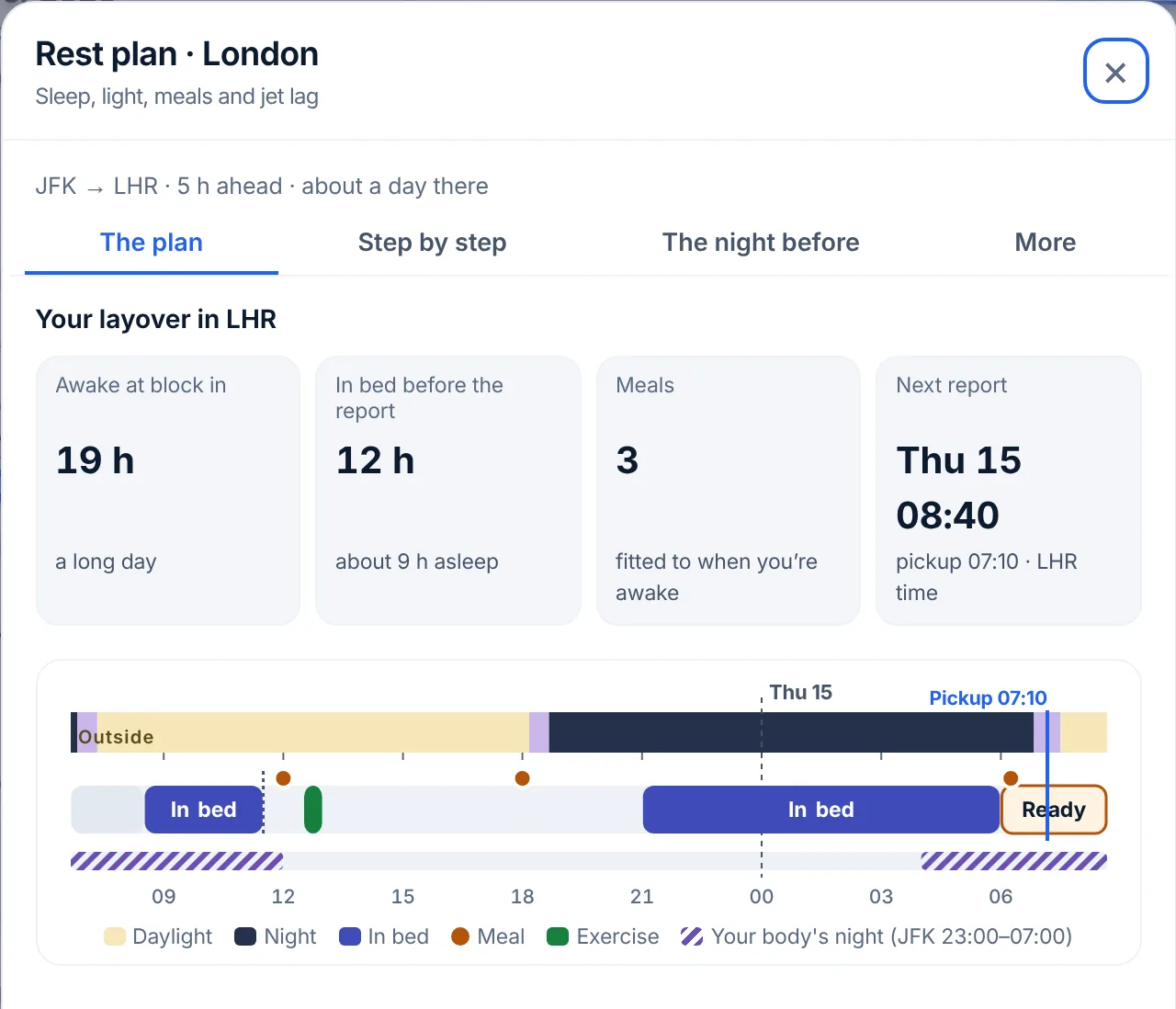
The full plan is a dialog with tabs: The plan (the layover at a glance: four tiles and the layover strip), Step by step (the table of steps, each with its reason), The night before (the dials for when you got up, sleep in flight and bed the night before; it reads Your hours when it has no dials to show, and it holds Your usual hours too) and More (the reasons and notes). Every number on the dials can be changed. Changes show at once but stay only when you tap Save changes; Discard puts them back. The dials are kept on that trip, your usual hours apply to every plan, and both sync with your account.
What the rest plan decides
The plan protects 8 hours of sleep before the report when the layover allows it, then fits everything else around that. In order:
- Getting to the room. Block-in plus the times above, rounded up to the quarter hour.
- A short layover (under 10 hours from the room to getting ready): one sleep, as soon as you reach the room, with an alarm.
- The sleep on arrival, after a long day (16 hours or more awake at block-in, reaching the room between 05:00 and 19:00 local). The longest that still leaves you tired enough for the night: two sleep cycles (3 hours) ending by 15:30 with 8½ hours awake before bed; one cycle (90 minutes) with 8 hours; 20 to 30 minutes with 6 hours; or none. When you arrive in your body's night after 12 hours or more awake (a red-eye east), the sleep comes fast and deep, so the plan gives two cycles when they end near your body's usual wake time and by 16:00, else one.
- The night. At your usual bedtime here, earlier after a long day (once you'd pass about 20 hours awake, not before 20:30). Time in bed grows, later in the morning first and then earlier in the evening, until the sleep to expect reaches 8 hours, up to 9 hours in bed (or your usual night if longer). The plan expects about 88% of time in bed asleep in your body's night and about 65% in your body's day, so a night in your body's afternoon needs more time in bed for the same sleep, and the plan says when it can't get there.
- Before a night flight (a report between 15:00 and 03:00): no alarm in the morning, then a nap of one cycle ending half an hour before you start getting ready.
- Meals fitted to your hours awake, at least 4 hours apart (5 with two a day): breakfast within an hour of getting up, dinner about 3 hours before bed, nothing big in the 90 minutes before sleeping, and light snacks rather than meals in your body's night (about midnight to 6 a.m. body time). For the next flight, a meal about an hour after takeoff and, through the night where you land, one small snack instead of a meal.
- Optional exercise, 20 to 30 minutes outdoors after the arrival sleep, when it ends 3 hours or more before bed.
- Getting ready: up an hour before the pickup, or 90 minutes before the report without one.
Two special cases change the approach:
- A short westward layover with the flight back east next (under 36 hours, your body clock 3 hours or more ahead of local time): the plan keeps you on your body clock's hours, with bed near your body's bedtime, no alarm, and the nap before a night flight in your body's afternoon, as in Lowden and Åkerstedt's 1998 study.
- The next duty is only deadheads: the night aims for 8 hours less the sleep the deadhead allows, never under 6.
On layovers with 10 hours or more between reaching the room and getting ready, LogAloft also tries every reasonable way of splitting the time (the arrival sleep, a main sleep starting at any hour, a nap before the report) and scores each with the Three-Process Model of alertness, validated on airline crews (Ingre and colleagues, 2014). It switches to that schedule only when it leaves you clearly more alert on the next flight; the plan then says so and gives the expected sleepiness on the 1-to-9 Karolinska scale (7 is sleepy).
It learns how you sleep
After each planned sleep, the layover card asks "How did you sleep in London?" (in Trips, the card is on the day you arrived, the layover day, not on the day you fly out) with Well, OK, Badly or Skip, then lets you correct the times you were in bed and got up. Your answers tune two things, slowly and within limits: how much sleep the plan aims for (from 8 up to 9 hours, never less than 8) and how fast it expects your clock to move after flying east and west. Settings → Rest plans shows what it has learned, with Start over to go back to the research defaults.
A heads-up before you bid
On Today, LogAloft looks at the next 30 days. When two or more layovers would give under 7 hours of sleep before the report, or three or more reports fall in your body's night (midnight to 5 a.m. on your body clock), a heads-up appears with How to bid: the layovers in question and general advice, such as bidding 24 hours or more after overnight flights east.
Using it on a trip
- Once: open any rest plan and, on its The night before (or Your hours) tab, set Your usual hours to when you really sleep at home. If you commute, make sure your home airport and commuting are set in About you.
- Before a long leg: tap Breaks on its day in Trips (or on Today) and plan the rest periods, so the rest plan knows how much you'll sleep in flight.
- The day you fly: if you got up at an unusual hour, set the first dial in the rest plan. It changes how long you've been awake at block-in.
- After block-in: look at the layover card on the way to the hotel. Set an alarm for the end of the arrival sleep and for getting up, and check the pickup time against the plan.
- Before the next report: answer "How did you sleep?" with one tap. The question is on the layover card, which belongs to the day you arrived: in Trips, pick that day (not the day you fly out) to find it. Over a few trips, the plan fits itself to you.
Worked example: ZZ 92 to London
You're a first officer based at JFK, flying a two-pilot ZZ 92 to London Heathrow and ZZ 93 back the next morning. You usually sleep 23:00 to 07:00 New York time.
- Tuesday 13 October: up at 07:00 at home. Report 17:30 EDT, ZZ 92 leaves at 18:30 EDT (23:30 in London).
- Wednesday 14 October: block-in at Heathrow at 06:40 BST, after about 19 hours awake. There's no break on a two-pilot flight of 7 hours, so no sleep in flight is counted.
- Thursday 15 October: hotel pickup 07:10, report 08:40, ZZ 93 leaves at 09:40 BST. From block-in to report: 26 hours.
London is 5 hours ahead of New York. When you land, your body clock says 01:40, and its low point (around 04:00 New York, 09:00 London) is still ahead of you.
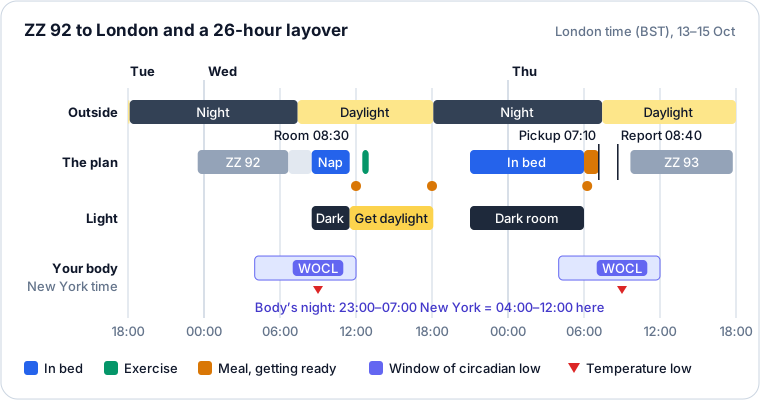
Here's what LogAloft's plan gives for this layover with those inputs:
| When (London) | Step | Why |
|---|---|---|
| 06:40–08:30 | To the room | Passengers off, passport control, 40 minutes to the hotel, check-in, settling in. |
| 08:30–11:30 | In bed: two sleep cycles, alarm set | You arrive in your body's night after 19 hours awake. The sleep comes fast and ends near your body's usual wake time. About 2 h 45 min asleep. |
| 11:30 | Up: daylight outside if you can | No more sleep until bedtime. Allow 30 minutes to an hour before anything that needs a clear head. |
| 12:00 | A light meal | Dinner is still a while off. |
| 12:30–13:00 | Exercise, optional | A walk outdoors counts. |
| 18:00 | Dinner | About 3 hours before bed. |
| 21:00–06:00 | In bed | 9 hours in bed for about 6 h 15 min asleep: most of it falls in your body's day, when sleep is shorter and lighter. |
| 06:00–07:10 | Get ready, with a quick breakfast at 06:15 | Up an hour before the 07:10 pickup. |
In total: about 9 hours of sleep before the report, so the card's line stays green. On ZZ 93 the plan suggests no full meal until it's morning in New York, with a light snack in between, because the first hours of the flight fall in your body's night.
A few things to notice:
- The 3-hour arrival sleep is deliberate. After a night awake, a 90-minute nap followed by a full afternoon up is very hard; two cycles that end near your body's usual wake time pay off part of the debt and leave the evening for a normal night.
- The night can't give 8 hours. With a 07:10 pickup, bed at 21:00 London time is 16:00 on your body clock. The plan uses the maximum 9 hours in bed and counts on the arrival sleep to make up the rest.
- Light. On a layover this short the plan doesn't try to move your clock. The dark room during the arrival sleep covers more than half of the hours when light would pull your clock toward London time; afternoon daylight falls in your body's morning, after the hours when light moves the clock most, and helps you stay up until bedtime.
If your schedule were different, so would the plan: a later pickup gives a later night; a night flight back adds a nap before the report; a 3-pilot crew with a planned break counts the sleep you got in the bunk and shortens the arrival sleep.
Breaks in flight
On a crew leg of 5 hours or more (on its day in Trips, or on Today), Breaks splits the rest periods (pilots: 2, 3, 4 or 6; flight attendants: groups between the services), shades your window of circadian low, and can put the alarms in your calendar. Its plan feeds the rest plan: 80% of your break counts as sleep in flight, which lowers your hours awake at block-in. If you slept more or less than that, set the Sleep in flight dial.
The day-by-day jet lag plan
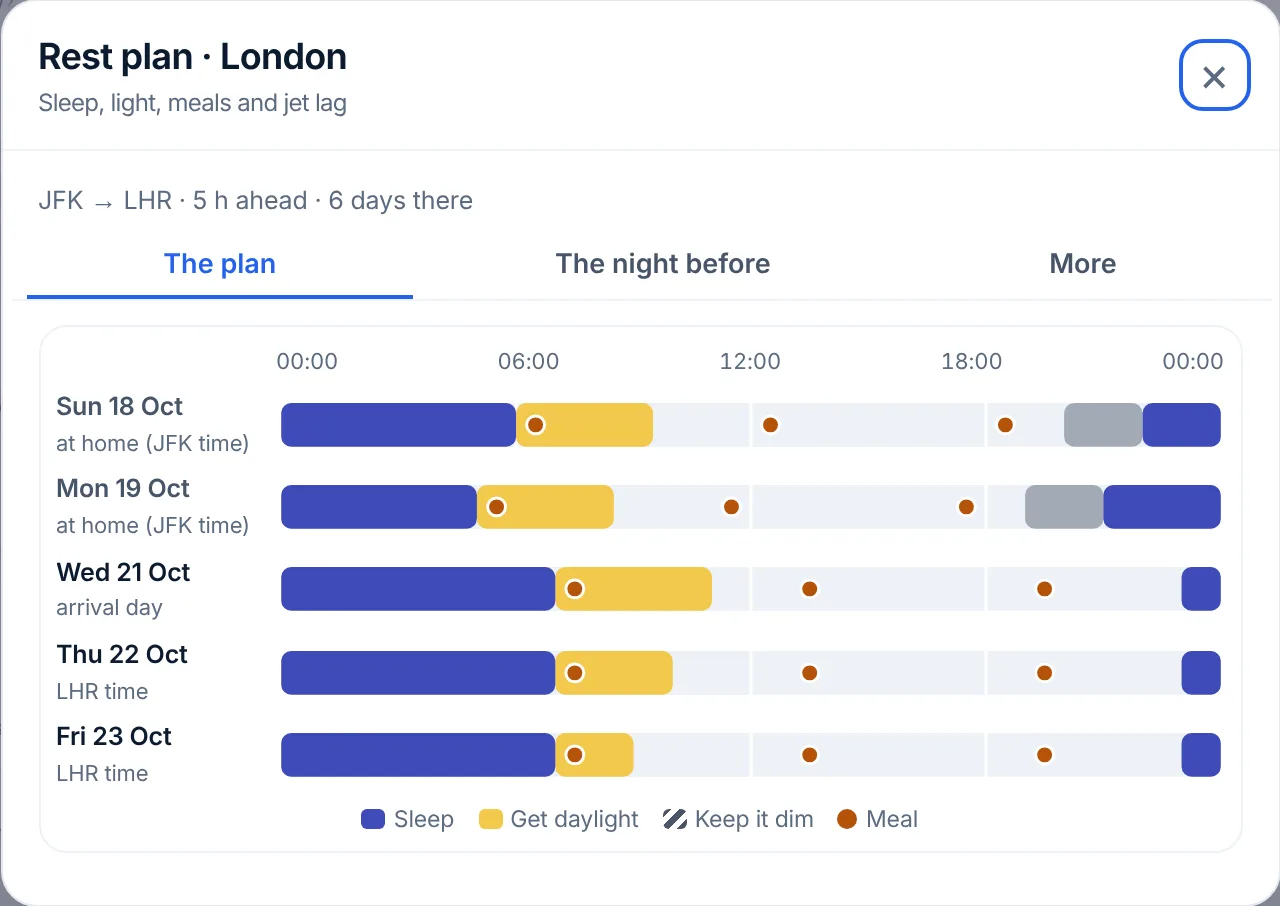
For a stay of more than three days across three or more time zones, The plan tab shows one row a day, each with a 24-hour bar. The day you travel has no bar of its own: the rows jump from the last day at home to the arrival day. A passenger trip has no Step by step tab, only The plan, The night before and More. The bars show:
- Sleep: your usual hours, local time.
- Get daylight: the hours when light moves your clock the right way, from your body's temperature low and the pace above.
- Keep it dim: the hours when light would push it the wrong way. Low lights indoors, sunglasses outside.
- Eat: breakfast, lunch and dinner times for the day.
Flying 5 hours east, for example, the windows to get daylight start right after waking and shrink each day as your clock catches up (about 1 hour a day). Flying west, they fall in the evening. From about nine hours east, the plan follows the clock the long way around and keeps you out of morning light at first.
Start shifting before you leave (under Your usual hours, on The night before or Your hours tab) adds 1 to 3 days at home before the trip, going to bed and getting up an hour earlier (east) or later (west) each day, with the light to match, as the CDC suggests. Mid-trip, or with too few days left, the plan starts when you arrive.
The plan ends with a note on melatonin, in general terms: the CDC says 0.5 to 1 mg is often enough and advises against more than 5 mg, which can stay in the body into the wrong time of day; timing matters more than the dose. With Pro, when a trip needs your body clock to move earlier (3 hours or more east, a stay of more than 2 days), the day-by-day plan marks an optional time: 0.5 mg about 6 hours before your body's bedtime, never in the last 3 hours before it (Burgess et al. 2010). For crews it never falls within 8 hours before a flight (LogAloft's margin; the FAA's guidance for sleep aids is occasional use and no flying within five times the longest half-life). US supplements aren't regulated. Ask your doctor first; pilots, your AME.
Common questions
Why does the plan put me in bed at 21:00 when I'm not tired?
Because the pickup is early and your body clock thinks it's afternoon, the plan needs more time in bed to get enough sleep. If you can't fall asleep, rest in the dark anyway; if the plan is consistently wrong for you, answer "How did you sleep?" and it adjusts.
The nap on arrival says 3 hours. Isn't that too long?
After a night awake and arriving in your body's night, a 3-hour sleep is two cycles that end close to your body's usual wake time, which keeps the grogginess low and leaves enough sleep pressure for the night. When the night ahead falls in your body's day and the sleep pressure is needed, the plan shortens it to one cycle or 20 to 30 minutes.
I'm a commuter. Which time zone is my body on?
Home time, not base time. LogAloft starts your body clock where you live when you've set your home airport and turned on commuting in About you.
Can I trust "about 9 h of sleep"?
It's an estimate of what most people get from that time in bed at that hour of their body clock. First nights away and noisy hotels give less. Treat it as the best case, protect the time, and nap when the plan allows.
What if the plan says I'll get less than 8 hours?
It says so in red on the card. Rest whenever you can, and if you're too tired to fly safely when the report comes, follow your company's fatigue procedure.
Sources
- The two-process model of sleep regulation: a reappraisal (Borbély, Daan, Wirz-Justice and Deboer), Journal of Sleep Research, 2016
- Contribution of the circadian pacemaker and the sleep homeostat to sleep propensity, sleep structure, electroencephalographic slow waves, and sleep spindle activity in humans (Dijk and Czeisler), Journal of Neuroscience, 1995
- 14 CFR 117.3 Definitions (window of circadian low) and 117.5 Fitness for duty (eCFR)
- Jet Lag Disorder, CDC Yellow Book 2026
- How to travel the world without jet lag (Eastman and Burgess), Sleep Medicine Clinics, 2009
- Using bright light and melatonin to reduce jet lag (Burgess), University of Pennsylvania
- Sleep inertia: current insights (Hilditch and McHill), Nature and Science of Sleep, 2019
- Strategic naps in automated driving: sleep architecture predicts sleep inertia better than nap duration (Tomzig et al.), Accident Analysis and Prevention, 2025
- Crew Factors in Flight Operations IX: Effects of planned cockpit rest on crew performance and alertness in long-haul operations (Rosekind et al.), NASA Technical Memorandum, 1994
- Fatigue in aviation: safety risks, preventive strategies and pharmacological interventions (Wingelaar-Jagt et al.), Frontiers in Physiology, 2021
- Caffeine effects on sleep taken 0, 3, or 6 hours before going to bed (Drake et al.), Journal of Clinical Sleep Medicine, 2013
- Eastward long distance flights, sleep and wake patterns in air crews in connection with a two-day layover (Lowden and Åkerstedt), Journal of Sleep Research, 1999
- Retaining home-base sleep hours to prevent jet lag in connection with a westward flight across nine time zones (Lowden and Åkerstedt), Chronobiology International, 1998
- Validating and extending the three process model of alertness in airline operations (Ingre et al.), PLoS ONE, 2014
- FAA Guide for Aviation Medical Examiners: sleep aids