Help › Trips, duty and rest
Duty and flight-time limits: FAR 117 and EASA
The flight duty, flight time and rest limits of 14 CFR Part 117 and EASA ORO.FTL in plain terms, how LogAloft builds your duty periods from your roster and checks them, and where its checks stop.
Duty limits are written in tables, rolling windows and definitions that interact in ways nobody remembers at 03:00 in a crew room. This guide lays out the rules of 14 CFR Part 117 for US pilots and EASA ORO.FTL for European crews, then shows how LogAloft turns your roster into duty periods, which limits it checks and where you see the result: Reports → Duty & rest, the chips on each duty day in Trips and the What if… tool for a delay or an added leg. It also lists what LogAloft does not check, so you know where your company's system has to take over.
LogAloft is a record-keeping and planning aid. It is not an approved scheduling system or fatigue risk management system, and it only knows what's in your logbook. Your company's procedures, its approved scheme and your authority's rules decide whether a duty is legal, and so does your own judgment: under 14 CFR 117.5, you must not fly a duty you're too fatigued to fly safely.
The words that matter
Part 117 uses a handful of defined terms (14 CFR 117.3), and most misunderstandings start with them:
- Flight duty period (FDP): starts when you report for duty with the intention of flying (including positioning) and ends when the aircraft is parked after the last flight segment. Deadhead transportation, training and airport standby before a segment are part of it.
- Duty: anything the company requires of you, FDP included: deadheading, training, administrative work. Duty is not rest.
- Rest period: a continuous period, planned in advance, free from all restraint by the company.
- Acclimated: you've been in a theater for 72 hours, or had at least 36 consecutive hours free from duty there. A theater is an area where your FDP's departure and arrival points differ by no more than 60 degrees of longitude.
- Window of circadian low (WOCL): 02:00 to 05:59 during a physiological night.
- Deadhead transportation is duty, but it isn't a flight segment for Table B.
The FAR 117 limits
Flight time per FDP: 117.11
| Crew | Report time (acclimated) | Maximum flight time |
|---|---|---|
| Two pilots (Table A) | 00:00–04:59 | 8 hours |
| Two pilots (Table A) | 05:00–19:59 | 9 hours |
| Two pilots (Table A) | 20:00–23:59 | 8 hours |
| Three pilots | Any | 13 hours |
| Four pilots | Any | 17 hours |
Flight time here is block time. If unforeseen circumstances arise after takeoff, the limit (and the cumulative flight-time limits) may be exceeded as far as necessary to land at the destination or an alternate (117.11(b)).
Flight duty period, two pilots: 117.13 and Table B
The maximum FDP depends on when it starts, in acclimated local time, and on the number of flight segments.
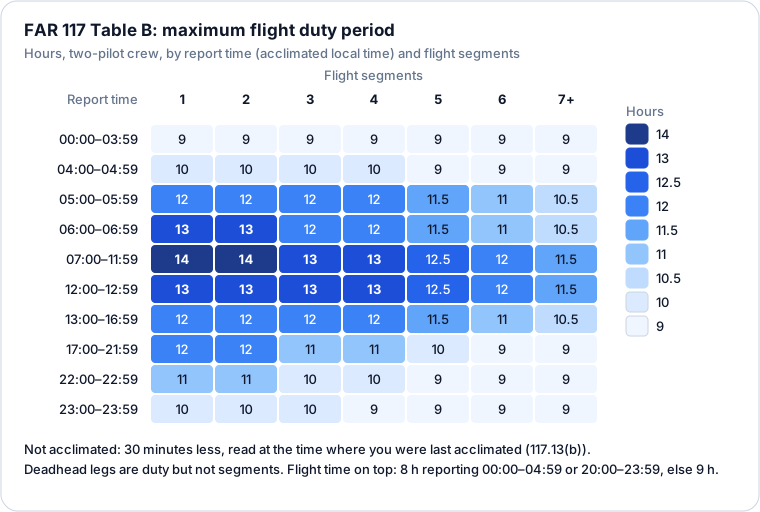
Two adjustments apply:
- Not acclimated: the limit is 30 minutes shorter, and the start time is read in the local time of the theater where you were last acclimated (117.13(b)).
- Extensions: if unforeseen circumstances arise before takeoff, the PIC and the company may extend the FDP by up to 2 hours; an extension of more than 30 minutes may happen only once before you get the 30-hour rest of 117.25(b), and never past the cumulative limits (117.19(a)). After takeoff, the FDP may run as long as needed to land safely (117.19(b)).
Split duty (117.15) lets the time in a suitable accommodation between 22:00 and 05:00 not count toward the FDP, under strict conditions. LogAloft doesn't model it (see the limits below).
Augmented crews: 117.17 and Table C
With a third or fourth pilot, the maximum FDP depends on the onboard rest facility:
| Report time (acclimated) | Class 1 (bunk): 3 / 4 pilots | Class 2 (lie-flat seat): 3 / 4 | Class 3 (seat): 3 / 4 |
|---|---|---|---|
| 00:00–05:59 | 15 / 17 | 14 / 15.5 | 13 / 13.5 |
| 06:00–06:59 | 16 / 18.5 | 15 / 16.5 | 14 / 14.5 |
| 07:00–12:59 | 17 / 19 | 16.5 / 18 | 15 / 15.5 |
| 13:00–16:59 | 16 / 18.5 | 15 / 16.5 | 14 / 14.5 |
| 17:00–23:59 | 15 / 17 | 14 / 15.5 | 13 / 13.5 |
The same 30-minute reduction applies when you're not acclimated. An augmented FDP may have at most three flight segments, and must give the pilot flying the landing two consecutive hours of in-flight rest in the second half of the FDP, and the pilot monitoring 90 consecutive minutes (117.17(c) and (d)).
Cumulative limits: 117.23
| Limit | What counts |
|---|---|
| 100 hours of flight time in any 672 consecutive hours | All flying on behalf of any Part 121 certificate holder or 91K program manager |
| 1,000 hours of flight time in any 365 consecutive calendar days | The same |
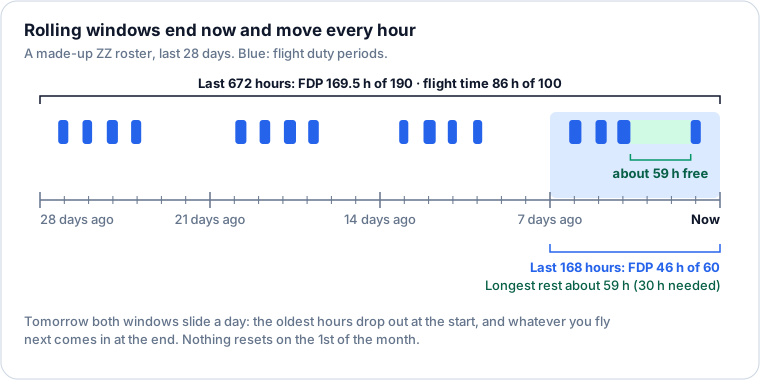
| 60 hours of FDP in any 168 consecutive hours | Flight duty periods |
| 190 hours of FDP in any 672 consecutive hours | Flight duty periods |
These are rolling windows. They end at the moment you look and slide forward every hour; nothing resets on the 1st of the month or on Monday.
Rest: 117.25
- Before any FDP or reserve: at least 10 consecutive hours of rest, measured from release from duty, with an opportunity for 8 uninterrupted hours of sleep (117.25(e)). If you can see the rest won't give you 8 hours of sleep opportunity, you must tell the company, and you can't report until you've had it (117.25(f)).
- Every week: at least 30 consecutive hours free from all duty within the 168 hours before any FDP or reserve (117.25(b)). Thirty-six hours of rest in a new theater both acclimates you and meets this (117.25(c)).
- After a long international trip: 56 consecutive hours of rest on return to home base, including three physiological nights, if you traveled more than 60 degrees of longitude during an FDP or series of FDPs and were away from home base for more than 168 consecutive hours (117.25(d)).
- After a long deadhead: if a deadhead exceeds the applicable Table B FDP, the rest before your next FDP must be at least as long as the deadhead (117.25(g)).
Reserve: 117.21
On short-call reserve, the reserve availability period (RAP) can't exceed 14 hours, and from the start of the RAP to the end of the FDP may not exceed Table B plus 4 hours or 16 hours, whichever is less (Table C plus 4 hours when augmented).
The EASA limits (ORO.FTL)
EASA sets the frame in Regulation (EU) No 965/2012, Subpart FTL, and each operator's approved flight time specification scheme fills in details, usually following the certification specifications (CS FTL.1).
Maximum daily FDP: ORO.FTL.205(b)
For acclimatized crew, by the start of the FDP at reference time and the number of sectors:
| Start of FDP | 1–2 sectors | Each sector after 2 |
|---|---|---|
| 06:00–13:29 | 13:00 | 30 minutes less |
| 13:30–16:59 | 12:45, then 15 minutes less every half hour (11:15 at 16:30) | 30 minutes less |
| 17:00–04:59 | 11:00 | 30 minutes less |
| 05:00–05:59 | 12:00 at 05:00, 15 minutes more every quarter hour (12:45 at 05:45) | 30 minutes less |
The FDP is never less than 9:00 from the table, whatever the number of sectors (up to 10 sectors). In an unknown state of acclimatization, the limit is 11:00 for 1–2 sectors, 30 minutes less for each sector after that, down to 9:00.
The operator may extend the FDP by up to 1 hour, at most twice in any 7 consecutive days, with more rest before and after (ORO.FTL.205(d)); CS FTL.1.205(b) sets when that is allowed, and it isn't allowed at all for FDPs starting between 19:00 and 06:14. With in-flight rest and one extra pilot, the FDP can reach 16, 15 or 14 hours with class 1, 2 or 3 rest facilities; with two extra pilots, 17, 16 or 15 hours; at most 3 sectors, and 1 hour more for an FDP with one sector of more than 9 hours of continuous flight time and at most 2 sectors (CS FTL.1.205(c)). After an FDP with in-flight rest, the rest at destination is at least as long as the duty before it, or 14 hours.
Cumulative limits: ORO.FTL.210
| Limit | Window |
|---|---|
| 60 duty hours | Any 7 consecutive days |
| 110 duty hours | Any 14 consecutive days |
| 190 duty hours | Any 28 consecutive days |
| 100 hours of flight time | Any 28 consecutive days |
| 900 hours of flight time | Any calendar year |
| 1,000 hours of flight time | Any 12 consecutive calendar months |
Note that EASA's 7-, 14- and 28-day limits count all duty, not only flight duty.
Rest: ORO.FTL.235
- At home base: at least as long as the preceding duty period, or 12 hours, whichever is greater.
- Away from home base: at least as long as the preceding duty period, or 10 hours, whichever is greater, including an 8-hour sleep opportunity.
- Recurrent extended recovery rest: at least 36 hours including 2 local nights, with no more than 168 hours between the end of one and the start of the next, and extended to 2 local days twice a month.
How LogAloft builds your duty periods
Everything starts from your logbook and roster:
- Report time. When your roster gives a report time (most airline calendars and line sheets do), LogAloft uses it. Otherwise it assumes you report a set time before the first departure: 60 minutes unless you change Report before the first flight (min).
- Grouping. Legs with the same report time are one duty period. Without report times, legs less than 7 hours apart are one duty period.
- Release. The duty ends a set time after the last arrival: 15 minutes unless you change Release after the last arrival (min). The FDP ends at the last operating leg's block-in.
- What counts as duty. Operating legs, deadheads, simulator sessions your roster gives a duty for, and reserve and ground duties from your roster. A deadhead before your first operating leg is part of the FDP; one after your last isn't. Commuting and passenger legs aren't duty.
- Segments and flight time. Only operating legs are segments. Flight time is their block time.
- Augmented crews. A duty is treated as augmented when a leg has three or more pilots in its crew list (captain, first officer and relief pilot entries), or you're logged as Relief pilot. Table C is read with the class you choose under Crew rest (augmented): Class 1 (bunk), Class 2 (lie-flat seat) or Class 3 (seat).
- Acclimation. You start acclimated at your crew base (Settings), or where your first duty starts if no base is set. A duty that starts after 36 hours or more off acclimates you there; 72 hours in another theater (more than 60 degrees of longitude from where you were acclimated) does too. When you're not acclimated, the table is read in the time zone where you last were, and the limit is 30 minutes shorter. The duty line says "not acclimated (JFK time)", for example.
For EASA, LogAloft reads acclimatization the same way as for FAR 117 (72 hours in a theater or 36 hours off). EASA's own rule uses a table of time-zone difference against time elapsed, so the app's answer is a simplification; your operator's scheme decides.
Where you see the checks
Reports → Duty & rest
Duty & rest is a long tab. When it doesn't fit your screen, its sections (the rolling totals, Coming up, Recent duty periods and the settings below them) become a row of chips at the top of the tab, and one section shows at a time. Tap a chip to switch. The picture shows the sections all at once.
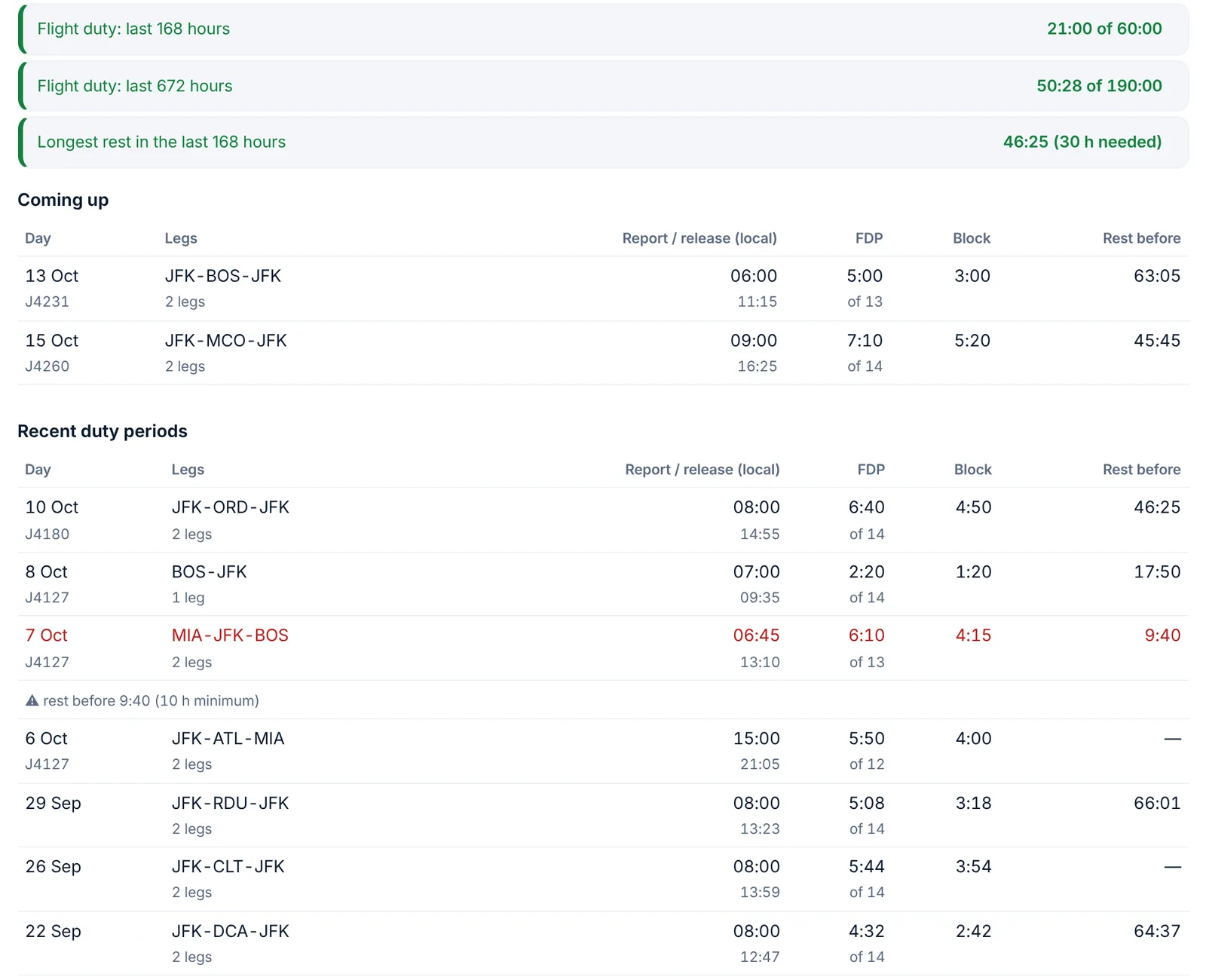
At the top, the rolling totals for your rules. With FAR 117:
- "Flight duty: last 168 hours" (for example "46:00 of 60:00"),
- "Flight duty: last 672 hours" (against 190),
- "Longest rest in the last 168 hours" (against 30 hours).
With EASA: duty in any 7, 14 and 28 consecutive days (60, 110 and 190 hours) and the longest rest in the last 168 hours, against 36 hours with 2 local nights.
Then two tables, Coming up and Recent duty periods, with the day, the legs, the report and release times (local), the FDP with its limit under it ("of 13"), the block time and the rest before. A duty that breaks a limit is shown in red, with the reason under it, for example "FDP 13:20 over 13 h (table B; within the 2 h an extension allows)", "flight time 9:25 over 9 h" or "rest before 9:40 (10 h minimum)".
The flight-time windows (100 hours in 672 and 1,000 in 365 days for FAR 117; 100 in 28 days, 900 in the calendar year and 1,000 in 12 calendar months for EASA) are in Reports → Currency, under Flight-time limits, as rings that fill toward the limit: amber from 90%, red past it. The Today screen shows the first two as its flight-time card.
Choosing your rules
Open How duty is counted · per diem and pay at the bottom of Duty & rest (with section chips, it's under the last chip):
- Under Duty rules, choose FAR 117 (US pilots), FAR 121.467 (US flight attendants), EASA (ORO.FTL, flight and cabin crew), one of the other countries listed, or My own rules (enter them below) for an authority LogAloft doesn't cover, then fill in its limits under Your own rules.
- Set Report before the first flight (min) and Release after the last arrival (min) to your company's times. They're used only where your roster has no report time.
- If you fly augmented, choose your aircraft's Crew rest (augmented) class.
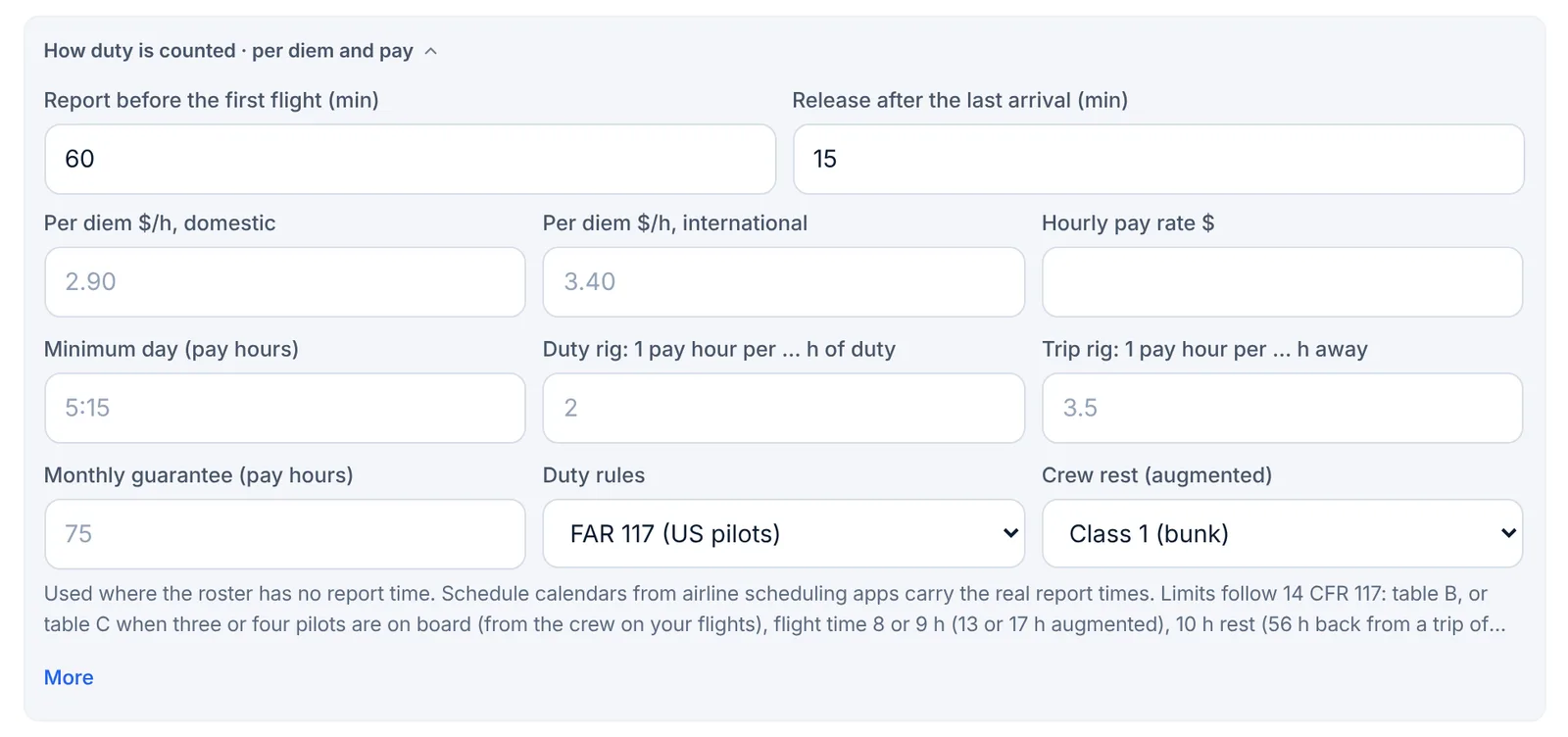
Without a choice, LogAloft picks from your crew base and airline: FAR 117 for US pilots, FAR 121.467 for US flight attendants, EASA in Europe.
Your contract's stricter limits
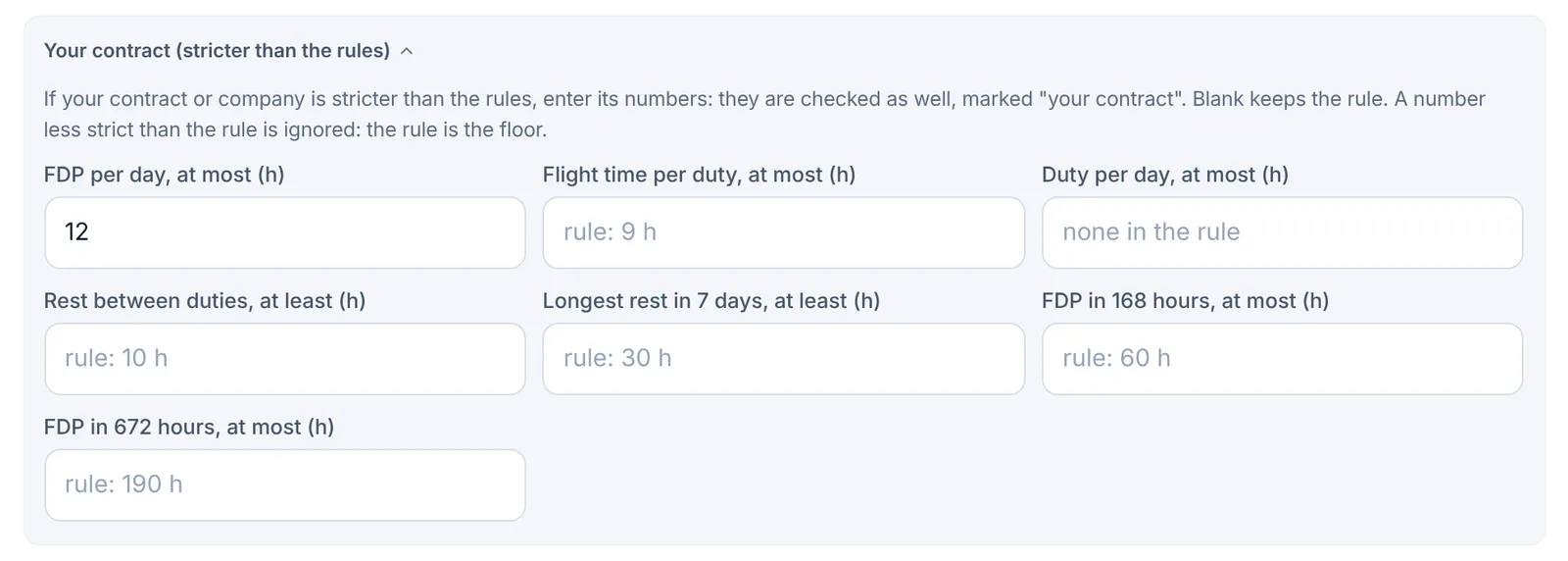
Many contracts are stricter than the regulation: a shorter duty day, a longer minimum rest, a lower monthly cap. Open Your contract (stricter than the rules) in Duty & rest and enter yours. For FAR 117 the fields are FDP per day, at most (h), Flight time per duty, at most (h), Duty per day, at most (h), Rest between duties, at least (h), Longest rest in 7 days, at least (h), FDP in 168 hours, at most (h) and FDP in 672 hours, at most (h); each shows the rule's number as a placeholder. EASA has its own set (FDP and duty per day, rest, the 7-, 14- and 28-day duty totals).
A limit you enter is checked as well as the rule and marked "your contract" ("FDP 12:40 over 12:00 (your contract)"). The rule stays the floor: a number less strict than the regulation is ignored, and the form says so. For flight-time windows, the same kind of override is in Reports → Currency → Flight-time limits, under "Your contract, if stricter".
Trips: chips and "What if…"
On each duty day in Trips (the The day tab beside the calendar on a computer), two chips can appear: under 10 h rest when the rest before an operating duty, from release to report as in the Duty & rest tab, is shorter than 10 hours, and the 117.25(b) check, red as "No 30 h rest in the 7 days before" or amber as "30 h rest in 7 days: … tight" when the longest rest in the 168 hours before the report is under 32 hours. Coming up explains the rest of that screen.
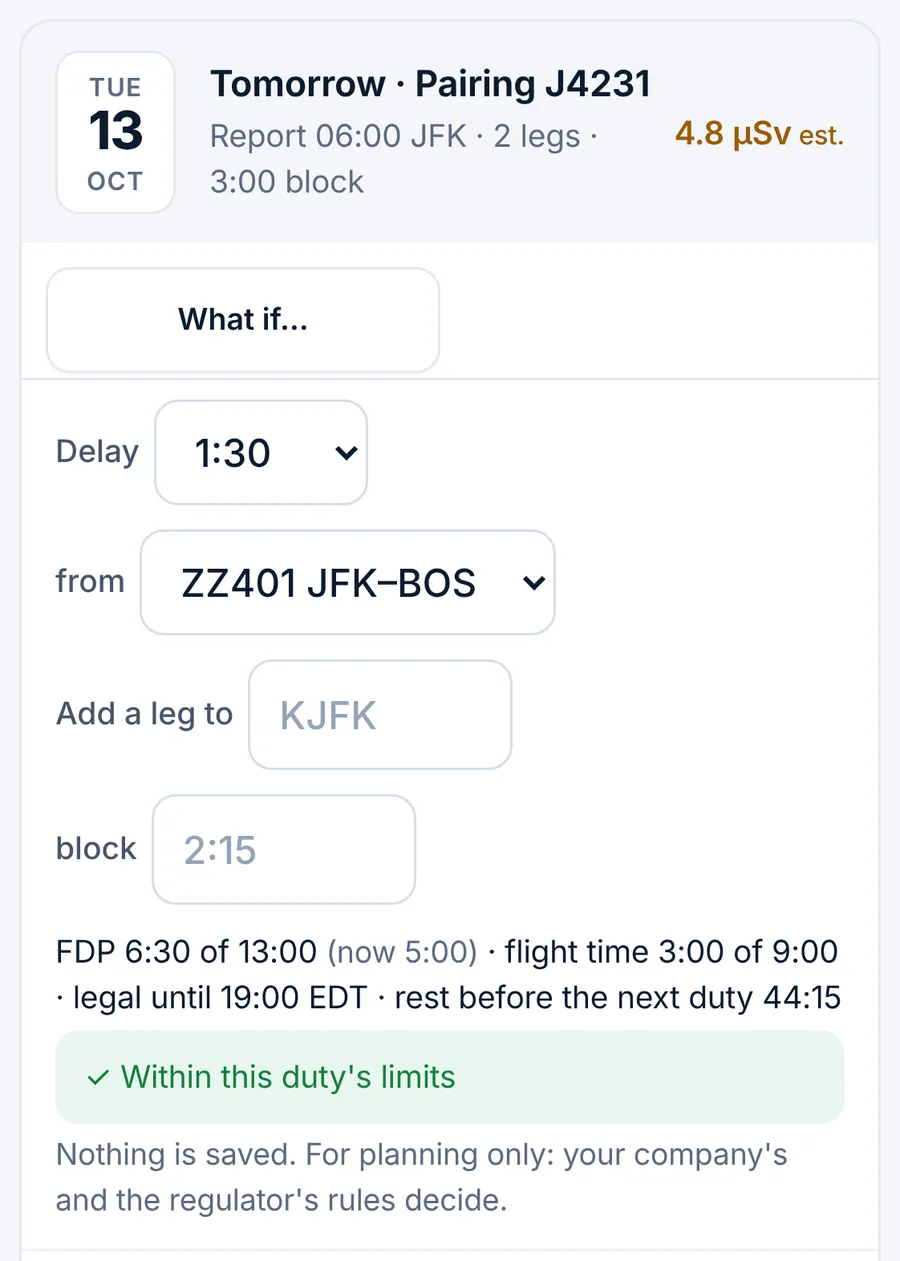
What if… on a work day recalculates that duty without saving anything:
- Tap What if… under the day.
- Choose a Delay (15 minutes to 10 hours) and the leg it starts from; later legs keep at least 30 minutes on the ground.
- Or Add a leg to an airport, with its block time (2:15, 2.25 or 2h15).
- Read the result: the FDP against its limit, the flight time, "legal until" with the latest time the FDP can end, and the rest before your next duty. Problems are listed in red; otherwise "Within this duty's limits".
When LogAloft has live estimated times for your legs (from the same feed as gates and delays), it applies them too: when a delay brings the duty within an hour of its limit, or past it, the day shows a "With the delay" chip.
Short-call reserve
Under Short-call reserve (117.21) in Duty & rest you can add your reserve availability periods. LogAloft then checks the 14-hour RAP limit and the Table B plus 4 hours (or 16 hours) limit from the start of the RAP, in local time at your base.
What LogAloft doesn't check
Knowing the gaps matters as much as the checks:
- Split duty (117.15) and EASA split duty aren't modeled. A break of 7 hours or more without report times splits the day into two duty periods; a shorter one counts in full as FDP.
- Augmented FAR 117 rules beyond Table C: the 3-segment maximum and the in-flight rest periods of 117.17(c) and (d) aren't checked.
- Consecutive nighttime operations (117.27), the deadhead rest of 117.25(g) and the "once before a 30-hour rest" condition on extensions (117.19) aren't tracked.
- The cumulative limits are shown as of now. Reports shows your totals up to this moment; it doesn't project the 60-hour, 190-hour or 100-hour windows to a duty next week. Trips does check the 30-hour rest ahead.
- All operating flying counts toward the flight-time windows, including personal general aviation flying that 117.23 wouldn't count. If you fly for fun, your totals will be on the high side.
- EASA: the extension table of CS FTL.1.205(b) is checked only for its start times: an FDP over its limit that starts between 19:00 and 06:14 says no extension is allowed (CS FTL.1.205(b)); one that starts 06:15 to 18:59 and stays within an hour of the limit says it's within the hour an extension allows, twice in 7 days, without checking the rest of the table or how many extensions you've had. The extra hour for a long sector with in-flight rest, reduced rest, the 2-local-nights condition of the 36-hour recovery rest and operator-specific scheme values aren't checked. An FDP using that extra hour can show as over the limit when it isn't.
- Anything not in your logbook isn't duty to LogAloft: an office day, a training day that isn't on your roster, a phone call during rest.
Common questions
My FDP limit shows 12.5 hours but my company says 13.
Check the report time and the segments. Table B is read at the report time in acclimated local time, and only operating legs are segments: a deadhead leg counted as a segment by mistake (logged as Operating crew) shortens the limit. If you're not acclimated, the line says so and the limit is 30 minutes shorter.
Why is my report time an hour before departure?
Your roster didn't include report times, so LogAloft used the default. Import the calendar from your airline's scheduling app (it usually carries them), or set Report before the first flight (min) to your company's standard.
Does commuting count as duty?
No. Commuting to base isn't duty under Part 117, and LogAloft doesn't count it toward FDP, duty or rest. Trips shows time at base after a commute as time there, not as rest.
I fly under Part 121 but not Part 117 (cargo). What applies?
Part 117 covers passenger operations under Part 121. All-cargo carriers may follow the older rules or opt into Part 117. LogAloft's Flight-time limits include a "FAR 121.471 (domestic, non-117)" set; for the rest, choose the rules your operator uses or enter them as your own rules.
Can LogAloft check a trip before I bid it?
Not as a trip on its own: it checks duties that are in your logbook. What you can do is read the rolling totals at the top of Duty & rest (how much of the 60, 190 and 100 hours you've used as of today), add what the trip would bring, and use What if… on a day you already have to see how a delay or an extra leg changes it.
Can I print this for my union or scheduling?
Print or save as PDF in Duty & rest prints the totals and the tables. It's your record, not a legal finding.
Sources
- 14 CFR Part 117, Flight and duty limitations and rest requirements: flightcrew members (eCFR)
- 14 CFR 117.3 Definitions; 117.11 Flight time; 117.13 and Table B; 117.17 and Table C; 117.19 Extensions; 117.21 Reserve; 117.23 Cumulative limitations; 117.25 Rest (eCFR)
- FAA Advisory Circular 117-3, Fitness for Duty
- Easy Access Rules for Air Operations, Regulation (EU) No 965/2012: ORO.FTL.205, ORO.FTL.210, ORO.FTL.235 and CS FTL.1.205 (EASA)