Help › Cosmic radiation
Cosmic radiation for aircrew: the complete guide
Where the radiation at cruise comes from, what makes it rise and fall, how much crews get in a year, what the ICRP, the EU and the FAA say about it, and what you can do.
After reading this you'll know what cosmic radiation is, why one flight gives three times the dose of another of the same length, how a year of flying compares with the radiation everyone gets on the ground, which rules apply to you in the US and in the EU, and what you can actually do about it. It's written for pilots and flight attendants who want to understand the numbers LogAloft shows them, not just read them. For how LogAloft itself works out a flight's dose, see How LogAloft works out your dose.
What it is
Cosmic radiation at cruise has two sources, and a third process that turns them into what you actually receive.
Galactic cosmic rays. Atomic nuclei, mostly protons, arriving from outside the solar system at close to the speed of light, from every direction and all the time. The FAA defines them as radiation "that originates outside the solar system, a main source of which is thought to be exploding stars (supernovae)" (AC 120-61B, paragraph 3e). On an ordinary day they give nearly all of a flight's dose.
Solar particles. The Sun also sends out energetic particles, mostly during flares and coronal mass ejections. The FAA calls the burst a solar particle event and notes that "the increase is usually very small relative to the background rate from galactic cosmic radiation," but "on rare occasions it can be significantly greater" (paragraph 3g). The biggest of these show up even at ground level and are called ground level enhancements. They matter mostly on polar and high-latitude routes. Solar storms and your flight covers the NOAA scales, the ICAO advisories and the big events.
The shower. These primary particles rarely reach an airplane intact. Each one hits a nitrogen or oxygen nucleus high in the atmosphere and sets off a cascade of secondary particles: neutrons, protons, electrons, muons and gamma rays. At airliner altitudes you fly inside that cascade, and neutrons carry a large share of the dose. The air below you then absorbs most of it before it reaches the ground. The background article Cosmic radiation, explained walks through the physics in more detail.
Everything above is ionizing radiation, meaning each particle carries enough energy to knock electrons out of atoms; inside a cell, that can damage DNA. Cell phones, Wi-Fi, radar and the airplane's radios emit non-ionizing radiation, and that's a different subject.
The unit: effective dose in sieverts
Doses are expressed as effective dose, in sieverts (Sv). It weights each type of radiation and each organ by how much harm it can do, so that a flight, a chest X-ray and a CT scan can be added up and compared. The numbers you'll see are small, so LogAloft shows millisieverts (1 mSv = 1/1,000 Sv) and microsieverts (1 µSv = 1/1,000 mSv). The current weighting is the one in ICRP Publication 103 (2007); the EU directive and the FAA's tables use it. Some airlines still report the older ICRP 60 weighting, which reads higher at cruise. How LogAloft works out your dose explains the difference.
What changes the dose rate
The FAA lists the variables in one sentence: the dose "depends on the amount of time in the air, altitude, latitude, and solar activity" (AC 120-61B, paragraph 9b). Time is simple multiplication. The other three set the rate, in µSv per hour.
Altitude
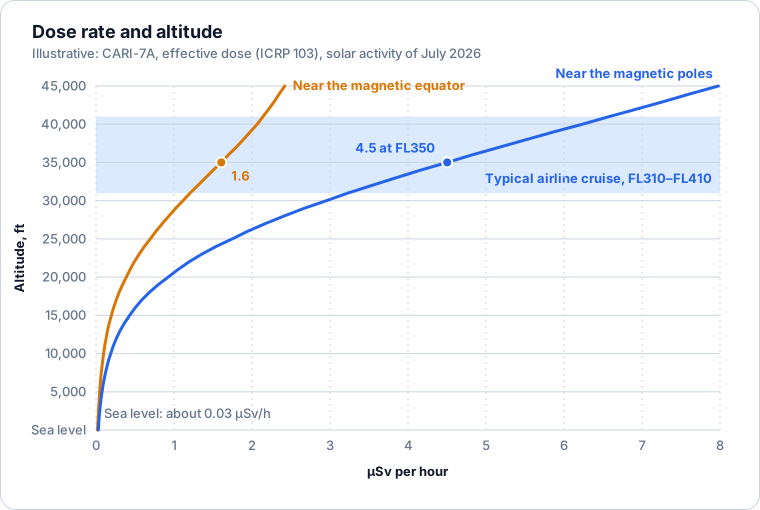
The higher you fly, the less air is above you to absorb the shower. The rate climbs steeply through the levels airliners use. In the CARI-7A model, at the solar activity of July 2026, the rate near the magnetic poles goes from about 0.19 µSv/h at 10,000 ft to about 3.0 at FL300, 4.5 at FL350 and 6.2 at FL400. Each 1,000 ft added at cruise is worth roughly 6 to 7% more near the poles, a little less near the equator. At sea level the same model gives about 0.03 µSv/h, so cruise is well over a hundred times the rate on the ground.
Geomagnetic latitude and cutoff rigidity
Earth's magnetic field steers charged particles. Near the magnetic equator the field lines run across the incoming particles' path and turn away all but the most energetic ones. Near the magnetic poles the field lines point down into the atmosphere and let almost everything in.
Physicists describe this with the cutoff rigidity, measured in gigavolts (GV): roughly, the minimum momentum per unit charge a particle needs to get through the field at that spot. It's about 15 GV or a little more near the magnetic equator, falls with latitude, and is close to zero over the polar caps. CARI-7A, and LogAloft, look up the cutoff at every position along the flight.
The effect is large. The FAA says galactic cosmic radiation levels "over the polar regions are about twice those over the geomagnetic equator at the same altitudes" (AC 120-61B, paragraph 6a). In CARI-7A at FL350 the ratio runs from about 2.5 at solar maximum to nearly 4 at solar minimum. Above about 55 to 60 degrees of geomagnetic latitude the curve flattens out: the field gives almost no protection there, so flying farther north doesn't add much more.
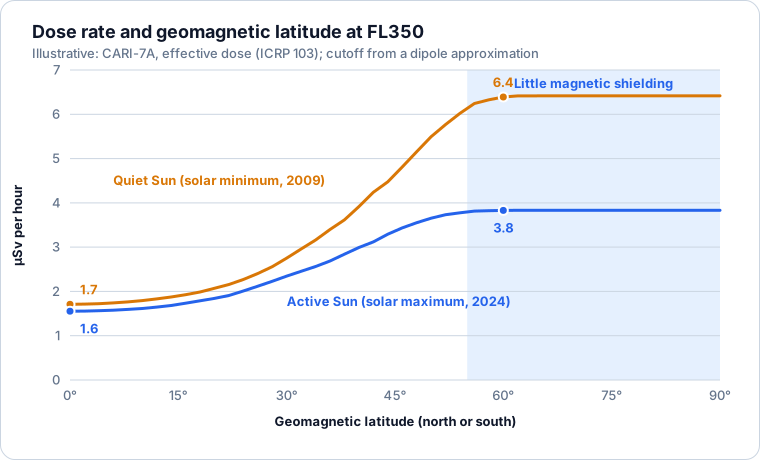
Geomagnetic latitude isn't geographic latitude. The magnetic pole sits in the Canadian Arctic, so the North Atlantic between the US and Europe is at a higher geomagnetic latitude than its geographic latitude suggests. That's one reason North Atlantic and transpolar flights run high rates, while flights to South America, Africa or Australia accumulate dose slowly even when they are long.
The Sun's 11-year cycle
The Sun's wind carries its magnetic field out past the planets and turns part of the galactic cosmic rays away before they reach Earth. When the Sun is active, near solar maximum, that shield is strongest and doses at altitude are lowest. Near solar minimum the shield relaxes and more cosmic rays get in (NOAA SWPC). This surprises people: a busy Sun means less radiation from deep space.
CARI-7A expresses the Sun's shielding as a monthly heliocentric potential, which the FAA publishes. In CARI-7A at FL350 near the poles, the rate was about 6.4 µSv/h at the October 2009 minimum and about 3.8 in October 2024, near the current maximum: about 40% lower. Near the equator the cycle changes the rate by only about 10%. NASA and NOAA announced in October 2024 that the Sun had reached the maximum phase of its cycle (NASA). As it quiets toward the next minimum, the same routes at the same levels will give a little more each year.
Solar storms work differently. A solar radiation storm can add dose on polar routes for hours. A geomagnetic storm (the kind that makes auroras) weakens the magnetic shield for a day or two, which matters most at low and middle latitudes, and often lowers the galactic cosmic-ray count for a few days at the same time. LogAloft keeps storm doses separate from the everyday galactic dose. See Solar storms and your flight.
Typical numbers
Per hour and per flight
| What | Dose | Source |
|---|---|---|
| Sea level, any latitude | about 0.02–0.03 µSv/h | CARI-7A (LogAloft grid), July 2026 |
| FL350 near the magnetic equator | about 1.6 µSv/h | CARI-7A, July 2026 |
| FL350 near the magnetic poles | about 4.5 µSv/h | CARI-7A, July 2026 |
| Miami–Tampa, FL240, 0.6 h | 0.41 µSv | AC 120-61B, Table 2 |
| London–New York, FL370, 6.8 h | 27.3 µSv | AC 120-61B, Table 2 |
| New York–Tokyo, FL430, 13.0 h | 55.1 µSv | AC 120-61B, Table 2 |
| New York–London, July 2026 | about 30 µSv | LogAloft calculation (blog) |
| Chest X-ray, two views | 0.1 mSv (100 µSv) | Mettler et al., Radiology 2008 |
The FAA's Table 2 figures were computed with CARI-7 for the mean solar activity of January 2000 and quiet geomagnetic conditions. How much radiation do you get on a flight? gives LogAloft's numbers for 14 routes, and shows how Los Angeles–Sydney, a 14.5-hour flight, comes out at about half the dose per hour of New York–Tokyo.
Per year
A year of flying is where the numbers start to matter.
- Aircrew, worldwide average: 2.7 mSv a year. That's the average reported to UNSCEAR for monitored civil aviation workers over 2000–2014. National averages for 2010–2014 ranged from 1.0 to 3.1 mSv (UNSCEAR 2020/2021, Annex D, paragraph 92). The FAA cites UNSCEAR's 2000 report, which ranked aircrews "the fourth most exposed group of employees, with an average annual effective dose of 3 millisieverts" (AC 120-61B, paragraph 5b).
- A worked example: 750 block hours a year at an average of 4 µSv/h, a typical rate for North Atlantic flying in mid-2026, comes to 3 mSv. The same hours on routes averaging 2 µSv/h come to 1.5 mSv.
So a crew member's flying roughly doubles the radiation they get from everything else. Two pilots with the same hours can end the year far apart: routes, levels and the Sun decide.
The rules
The international recommendations: ICRP
The International Commission on Radiological Protection doesn't make law, but national rules are built on its recommendations.
- Crews are occupationally exposed. ICRP Publication 132 (2016), its guidance for aviation, says "the exposure of aircraft crew should be treated as occupational exposure," and that passengers' exposure is public exposure. It treats cosmic radiation as an existing exposure situation and recommends keeping exposure as low as reasonably achievable, with a reference level for the most exposed individuals "typically in the 5–10 mSv year⁻¹ range."
- The occupational dose limit: 20 mSv a year averaged over defined five-year periods, with no single year over 50 mSv (ICRP 103, Table 6).
- The public dose limit: 1 mSv a year (ICRP 103, Table 6). It doesn't apply to passengers, but it's a useful yardstick.
- Pregnancy: once a worker declares a pregnancy, the dose to the embryo or fetus should not exceed about 1 mSv during the rest of the pregnancy (ICRP 103, paragraph 186).
The European Union: Directive 2013/59/Euratom
In the EU, the Basic Safety Standards Directive is binding law, transposed by each member state. It says aircrew exposure "should be managed as a planned exposure situation" (recital 26). The key article is 35(3):
| Crew dose liable to be | What the operator must do | Directive |
|---|---|---|
| Above 1 mSv a year | Assess the crew's exposure; take it into account when building schedules, "with a view to reducing the doses of highly exposed crew"; inform crew of the health risks and their individual dose; apply the pregnancy rule of Article 10(1) | Art. 35(3) |
| Above 6 mSv a year | The directive's wider occupational requirements apply, "allowing for the specific features of this exposure situation" | Art. 35(3); Art. 40 (category A workers) |
| Any amount | Occupational limit: 20 mSv in any single year (50 mSv in special circumstances if the five-year average stays at 20) | Art. 9(2) |
| Declared pregnancy | Equivalent dose to the unborn child "as low as reasonably achievable and unlikely to exceed 1 mSv during at least the remainder of the pregnancy" | Art. 10(1) |
National averages for aircrew reported to UNSCEAR, nearly all from European countries, range from 1 to 3 mSv a year, so most EU airlines with long-haul flying fall under Article 35. Crew doses are typically calculated with a model such as CARI-7A rather than measured with dosimeters (UNSCEAR 2020/2021, Annex D, paragraphs 89–96).
The United States: guidance, not a limit
The FAA's position is in Advisory Circular 120-61B, In-Flight Radiation Exposure (November 21, 2014). Its purpose is to help "improve air carrier programs that inform crewmembers about in-flight ionizing radiation exposure" (paragraph 1).
- It recognizes the exposure as occupational: "In aviation, ionizing radiation from natural sources is considered occupational exposure because of the high levels of galactic cosmic radiation at commercial cruise altitudes" (paragraph 5b).
- Recommended limits for a non-pregnant crew member are the ICRP's: "a 5-year average effective dose of 20 mSv per year, with no more than 50 mSv in a single year." The circular adds that these "are not thresholds beyond which the dose is intolerable but instead are upper limits of acceptability" (paragraph 7b).
- Pregnancy: "the FAA recommends she limit ionizing radiation exposure of her conceptus to no more than 0.5 mSv per month" (paragraph 7c).
- Managing exposure "should be based on the ALARA principle" (as low as reasonably achievable), and responding to a solar radiation alert by flying lower "can significantly reduce radiation exposure in high-latitude areas of concern" (paragraph 9b).
An advisory circular is guidance. No FAA regulation sets a dose limit for crew or requires an airline to measure, record or report crew dose. Whether your airline tracks it is up to the airline and, where one exists, your union contract.
This is a summary for your understanding, not legal advice. Your company's procedures, your national authority's rules (which may be stricter than the directive in EU member states) and your own doctor come first. LogAloft is a record-keeping and planning aid, not a dosimetry service and not your airline's official dose record.
Pregnancy
The unborn child is more sensitive to radiation than an adult, which is why the limits for a declared pregnancy are much lower than the occupational ones: about 1 mSv for the rest of the pregnancy (ICRP 103 paragraph 186; EU Article 10) and 0.5 mSv in any month (FAA, AC 120-61B paragraph 7c).
Put those next to a normal schedule. At 4 µSv/h, 75 block hours of North Atlantic flying is 0.3 mSv in a month: inside the FAA's monthly figure, but enough to pass 1 mSv in a little over three months. On low-latitude routes at 2 µSv/h, the same hours give 0.15 mSv a month.
What that means in practice:
- Tell your airline early if you want the protections that come with a declared pregnancy. In the EU, the employer's duty under Article 10(1) starts when you inform it.
- Know your airline's policy. It decides whether you keep flying, move to other routes or move to ground duties.
- Check what a schedule would add before you fly it. In LogAloft, turn on pregnancy tracking and compare trips before a bid. Both are explained in How LogAloft works out your dose.
- Talk to your doctor or your airline's medical department. They can put the numbers in the context of everything else about your pregnancy.
What you can do
Shielding isn't an option: stopping these particles takes meters of water or concrete, and the fuselage lowers the dose by up to about 8% (method). What works is managing the four variables.
- Know your number. Your dose depends on routes, levels and the Sun, not just hours, so a rough guess can be far off. LogAloft works out every flight and keeps a 12-month, yearly and career total.
- Mix your flying. Polar, North Atlantic and North Pacific flying gives the highest rates; South America, Africa and Australia routes the lowest per hour. If you bid, a few lower-latitude trips bring the year's total down noticeably.
- Compare trips before a bid. The dose difference between two pairings in the same month can be large. Weigh it beside pay, days off and seniority; whether it's worth trading any of those is your call.
- Respect solar radiation storms. When NOAA reports a solar radiation storm or ICAO issues a space weather advisory for radiation on your route, a lower level or a route farther from the poles cuts the extra dose. That decision belongs to the captain and dispatch, under the company's procedures.
- Look after the rest. Sun exposure on the flight deck and on layovers, and sleep disruption, are health factors for crews in their own right. Sunscreen, UV-blocking sunglasses and the usual screening for your age deal with much of the first.
Two things that don't help much: offsets and directs change the dose by well under 1% (method), and flying faster saves dose only in proportion to the time saved.
Health effects, in brief
Ionizing radiation is a known cause of cancer: the International Agency for Research on Cancer classifies it, neutrons included, in Group 1 (IARC Monograph 100D). No one has measured harm directly at aircrew doses. The risk is estimated from people who received much higher doses, assuming it scales down in proportion. For protection purposes the ICRP uses a nominal risk of about 5% per sievert (ICRP 103). By that yardstick, a 30-year career at 3 mSv a year (90 mSv in all) adds roughly half a percentage point to a person's lifetime cancer risk.
Studies of crews themselves give a mixed picture:
- Crews live longer than average. A pooled study of 93,771 crew members from 10 countries found overall mortality "strongly reduced" in male cockpit crew (standardized mortality ratio 0.56) and in female cabin crew (0.73). Deaths from radiation-related cancers were not raised in cockpit crew (0.73) and were similar to the general population in cabin crew (Hammer et al., 2014).
- Melanoma is the clearest excess. A meta-analysis of 19 studies found about twice the expected incidence in pilots (standardized incidence ratio 2.22) and cabin crew (2.09) (Sanlorenzo et al., 2015). Ultraviolet light, through the windshield and on layovers, is the leading explanation rather than cosmic radiation.
- A 2026 US study ranked pilots second of 503 occupations for the share of deaths from radiation-linked cancers. It measured proportions of deaths, not rates, and had no individual dose data. Pilots and the new cancer study explains what it shows and what it can't.
The fair summary: aircrew doses are well below occupational limits and above the public one, the estimated added risk is small but not zero, and the excesses actually seen in crews are mostly explained by other factors. That's a reason to know and manage your dose, not a reason for alarm.
What a dose means for your own health is a question for your doctor. Nothing here is medical advice.
See it for yourself
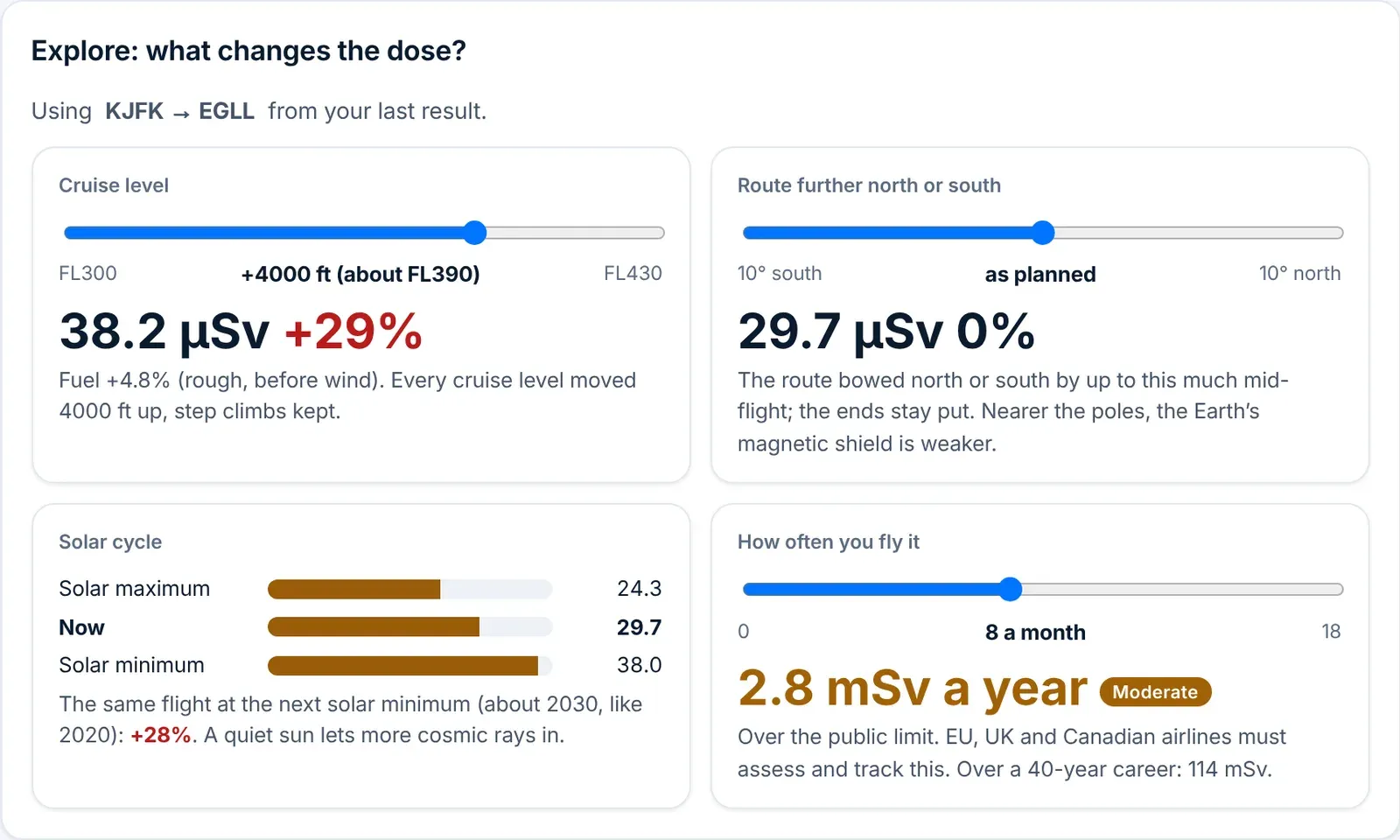
The dose lookup on the home page has an Explore tab, Explore: what changes the dose?, that shows each of the effects above on a real route. It uses the route of your last result (a city pair or a flight). Move the sliders: Cruise level from FL300 to FL430, Route further north or south by up to 10° (it starts at "as planned", the route as flown or planned, with the ends kept in place), and How often you fly it to see a year of it against the limits. Solar cycle has no slider: it shows the same flight at solar maximum, now and at solar minimum side by side. Below them, The globe: dose rate anywhere colors the whole planet by dose rate at the level and date you choose.
If you'd rather learn by doing, the game Fly the Dose has you pick the cruise level of a flight, dodging storms and traffic, and scores you on the dose you save against the autopilot; its classic cockpit adds the offset and the speed. See Fly the Dose: how to play.
Common questions
Is cosmic radiation the same as the radiation from airport scanners or the weather radar?
No. Airport body scanners at US checkpoints use millimeter waves, and weather radar uses microwaves; both are non-ionizing. Cosmic radiation is ionizing, the same kind as X-rays.
Does flying at night change the dose?
No. Galactic cosmic rays arrive from every direction day and night. The Sun's own particles matter only during solar storms.
Why is my dose higher this year with the same schedule?
Most likely the Sun. As it moves from maximum toward minimum, the same flights give more dose each year. A change of routes or cruise levels does the same.
My airline's numbers are about 30% higher than LogAloft's. Who is right?
Probably both. Some airlines still report the older ICRP 60 weighting, which comes out about 26–33% higher at cruise. You can switch LogAloft to it. See Dose standards.
Does the US have a dose limit for pilots?
No binding one. The FAA recommends the ICRP's occupational limits and 0.5 mSv a month during pregnancy in AC 120-61B, but no regulation sets a limit or requires monitoring.
Do I get more as a pilot than as a flight attendant on the same flight?
The rate is essentially the same throughout the airplane. Differences in annual dose come from hours, routes and levels flown.
Is a polar flight dangerous?
On an ordinary day, a polar flight gives a higher dose per hour than a southern route, but still within the range that makes up a normal crew year. The concern is the rare strong solar radiation storm, when operators may reroute or descend.
Sources
- FAA Advisory Circular 120-61B, In-Flight Radiation Exposure, November 21, 2014: paragraphs 3, 5, 6a, 7b, 7c, 9b; Tables 1 and 2.
- Council Directive 2013/59/Euratom (basic safety standards), EUR-Lex: recital 26, Articles 9, 10, 35 and 40.
- ICRP Publication 103: The 2007 Recommendations of the ICRP and Dose limits, ICRPaedia (Table 6 and paragraph 186).
- ICRP Publication 132: Radiological Protection from Cosmic Radiation in Aviation (2016).
- NCRP Report No. 160, Ionizing Radiation Exposure of the Population of the United States (2009).
- UNSCEAR 2020/2021 Report, Annex D: Evaluation of occupational exposure to ionizing radiation, paragraph 92.
- CARI-7 and CARI-7A, FAA Civil Aerospace Medical Institute; Copeland K., CARI-7A: development and validation, Radiation Protection Dosimetry 175 (2017) 419–431. The dose rates in the two charts and the per-hour table come from CARI-7A 4.2.0 runs (ICRP 103 effective dose) on LogAloft's grid.
- Galactic Cosmic Rays, NOAA Space Weather Prediction Center.
- NASA, NOAA: Sun Reaches Maximum Phase in 11-Year Solar Cycle, October 15, 2024.
- Mettler et al., Effective doses in radiology and diagnostic nuclear medicine: a catalog, Radiology 2008.
- IARC Monograph 100D: Radiation (2012).
- Hammer et al., Mortality from cancer and other causes in commercial airline crews, Occupational and Environmental Medicine 2014.
- Sanlorenzo et al., The risk of melanoma in airline pilots and cabin crew: a meta-analysis, JAMA Dermatology 2015.